Google, AI and Why Your Reviews Matter More Than Ever
If you haven't got hours to spend reading through 30 different articles on the latest marketing updates, I've done it for you. I've picked out some of last week's most interesting developments in Google, SEO and AI, and highlighted what I think businesses actually need to know.
This roundup is aimed at small and medium-sized businesses that don't want to wade through marketing jargon but do want to understand what's changing and how to keep their business visible online. All explained with as little jargon as possible, hope it's helpful.
AI might recommend your business, but customers still do their homework
Research from Feedvisor revealed that 16% of surveyed shoppers now start their product searches using ChatGPT. BUT only 5% say they immediately buy something after an AI recommendation. Instead, they're doing what we've always done when making a buying decision. Checking reviews, comparing prices, visiting websites and looking for reassurance. And here's another interesting stat, Similarweb found that 93.7% of ChatGPT's visitors also visited Google.
It doesn't necessarily mean they were checking the same purchase, but it does tell us something important. People aren't necessarily replacing Google with AI. They're using both.
What does this mean for your business?
Your online reputation is just as important as your visibility. It's all very well appearing in a ChatGPT (or other AI platforms) recommendations, but what happens when somebody searches for your business afterwards? Are your reviews recent (are you responding back to them)? Is your website professional and easy to use? Can they find clear information about your services, pricing and what to expect?
AI might introduce someone to your business, but your wider online presence still needs to give them the confidence to choose you.
Google is now putting AI-generated review summaries in search ads
This is a really interesting development for businesses running paid ads on Google. Google has introduced AI-generated review summaries that can appear directly within Search ads.
Instead of just showing a star rating, Google's AI can summarise positive things customers have said about a business in online reviews.
You might have already seen something similar on Trustpilot, which now uses AI to analyse customer reviews and produce a handy summary of what people are saying about a business.
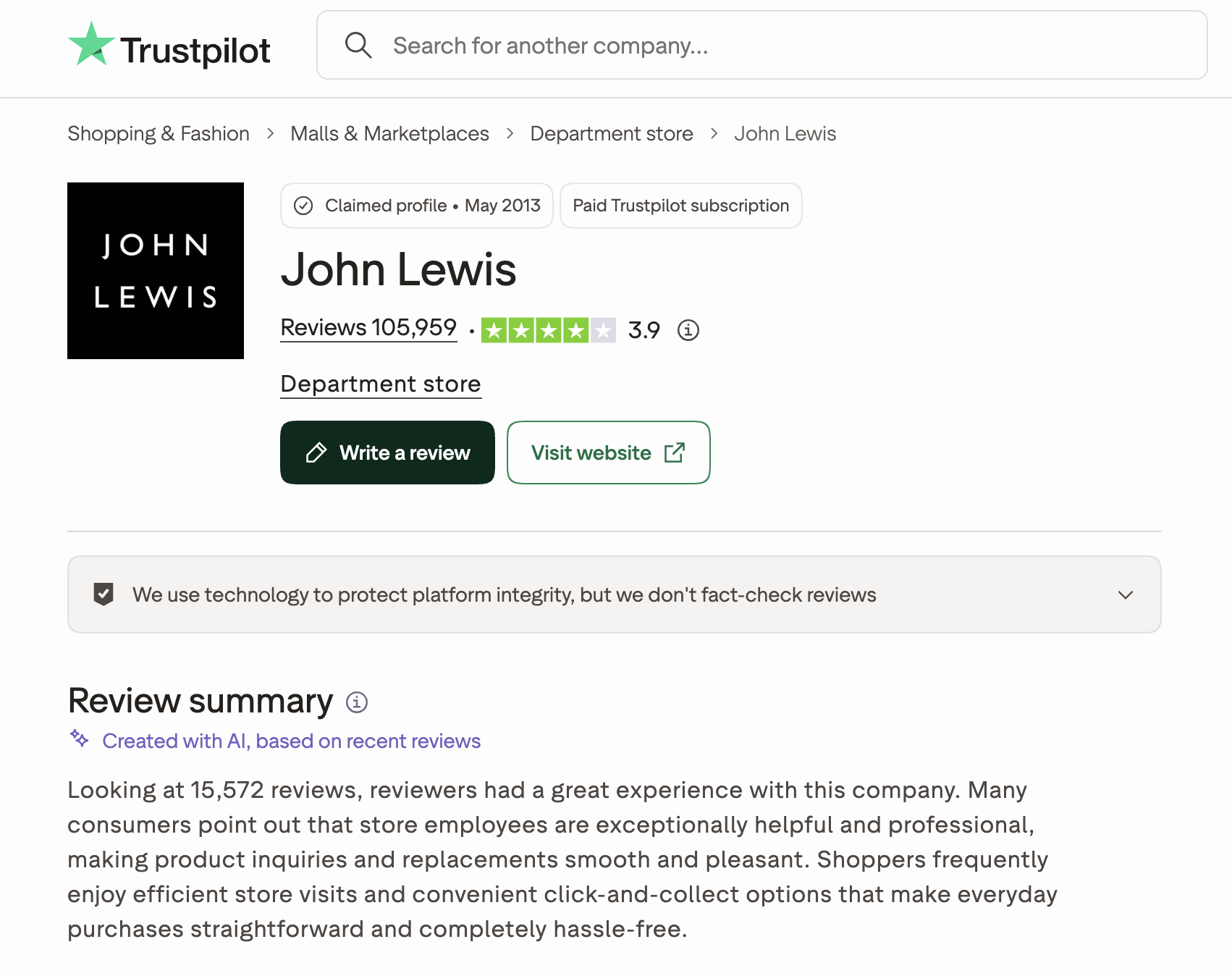
The difference is that Google's summaries can appear directly within a paid search ad, potentially giving customers reassurance before they've even visited your website. And you're paying Google, so they focus on positive feedback, and before you ask, it can't be edited by advertisers, and will only appear if Google predicts they'll improve ad performance.
What does this mean for your business?
It's another reminder of just how important your online reputation is becoming. I harp on about reviews all the time to my clients, but they're no longer just something potential customers read when they're researching your business, they're increasingly being used by AI to help people decide who to trust.
So, if you haven't asked your customers for reviews in a while, perhaps this is a good reminder. And don't just focus on the number of stars. The actual words your customers use to describe their experiences are becoming increasingly valuable.
And just to add, while this feature is already available in the UK, you won't necessarily see it on every Google ad. Google decides when to display these AI-generated review summaries based on whether it thinks they'll improve the ad's performance.
And one important distinction, this is not the same as placing ads inside Google's AI Overviews, which are not yet available in the UK.
You can read more about review summaries here.
Is all the excitement around AI search optimisation justified?
There's been quite a bit of debate about this recently. We all know AI is going to change the future (possibly end humanity as we know it, but this is a marketing newsletter, so we'll skip that bit!). SEO expert Marie Haynes analysed 100 websites, covering more than 145 million website sessions. She found that ChatGPT generated just 0.62% as many visits as Google organic search.
Not a huge amount, considering how much we're hearing about AI search. BUT there's another side to the research that I found particularly interesting. Of the 55 websites that were tracking conversions:
13.8% of ChatGPT visitors converted.
3.02% of Google organic visitors converted.
So, although ChatGPT sent significantly fewer visitors, those visitors were more likely to complete a tracked conversion in this particular sample. However, Google organic still delivered 27 times as many conversions as all the AI tools combined.
What does this mean for your business?
My personal view is that we're looking at this the wrong way. There's so much talk about traditional SEO versus AI optimisation, GEO, AEO and whatever other acronym comes along next. But ultimately, isn't it all about the same thing? Making sure your business can be found by the right people, wherever they're looking.
Whether that's Google, ChatGPT or another AI platform, the goal hasn't really changed. What has changed is how people search, where they look for information and how they make decisions about which businesses to trust. And this is where I think some of the conversation around AI optimisation gets a little carried away.
Good SEO has never just been about getting a website to rank for a handful of keywords. It's about understanding what your customers are looking for, answering their questions, providing genuinely useful information and building credibility. It's about having a website that's easy to navigate, clear information about your services, genuine customer reviews and other reputable websites that reference and trust your business.
That's a huge part of what we're now calling AI search optimisation. Yes, there are differences in how AI platforms discover, interpret and recommend businesses, and we need to understand those. But the foundations haven't suddenly disappeared. Even the way people write prompts into ChatGPT isn't entirely different from the long-tail, conversational searches we've been optimising content for over the years.
So my advice to small businesses would be not to panic or feel that you suddenly need a completely different marketing strategy. If you've been investing in good SEO, creating genuinely useful content, building your reputation and putting your customers first, you're already doing much of the right work.
You may need to adapt how you measure visibility and pay closer attention to where people are discovering your business, but you don't need to throw everything out and start again.
SEO isn't dead. It's evolving, just as it always has. It's no longer just about asking, "Where does my business rank on Google?" but rather, "Where are my customers looking, what information are they finding, and what gives them the confidence to choose me?"
Because whether it's SEO, GEO or AEO we're ultimately working towards the same goal of helping people find the right businesses, access useful information and make informed decisions.
You can read Marie Haynes's research here.
Google's latest spam update has finished rolling out
Google's September spam update finished rolling out on 8 October. I know I mentioned this in my last newsletter, but I've had a few questions about it since, so I thought it was worth revisiting and sharing a few things to look out for.
These updates are designed to improve the quality of Google's search results by reducing the visibility of websites that violate its spam policies. If you've noticed your website traffic or search rankings fluctuating recently, the update could be one possible explanation. But that doesn't necessarily mean Google has identified a problem with your website, so don't panic and start rewriting your website because a few keywords have dropped.
Look at the bigger picture. Are you still getting enquiries? Which pages have lost traffic? Has demand changed?
And remember, Google's updates don't automatically mean something is wrong with your website. The best approach is carrying on creating helpful, original content that answers the questions your customers are asking.
Read more on Search Engine Journal
Google is making website links more visible in AI answers
One concern about AI-generated search results has been that people can find the information they need without ever visiting the websites that provided it.
Well, Google has announced some changes and tests to make links to those websites more prominent in its AI search results. This could create more opportunities for businesses to attract visitors, although we don't yet know how much difference it will make to website traffic.
What does this mean for your business?
Give people a reason to visit your website, and just as importantly, a reason to stay. Useful advice, detailed service information, genuine examples, helpful guides and original content are all worth investing in.
Think about the questions your customers ask before buying. Could your website do a better job of answering them? And try to be more transparent where you can. Explain how you work, what your process looks like and what happens after someone fills in an enquiry form. Will you call them? How quickly can they expect to hear back? What happens next?
And here's another thought, particularly with Google making website links more visible in AI answers. Could you offer something that people can't get from a simple AI-generated answer?
Perhaps a downloadable planning guide, an interactive calculator, a useful checklist, a personalised quote or a free consultation? AI might be able to explain how to do something, but that doesn't mean it can always provide the practical tools or personalised advice someone needs to actually do it. And that's potentially a really good reason for someone to click through to your website.
It doesn't guarantee Google will link to your content, of course, but it's another reason to think beyond simply answering questions on your website.
And if someone wants to download a guide or receive more information, you may also have an opportunity to collect their contact details, with the appropriate permission, and continue the conversation when they're ready.
Read more on Search Engine Journal
A quick WordPress security reminder
Goodness, last week was a bit bonkers with this one. I've deliberately left it until last, as you may already be sick of hearing about it.
Two serious vulnerabilities in PHP (the programming language that powers WordPress and many other websites) prompted urgent security updates last week. There was also a separate security incident involving UpdraftCentral, a WordPress management service. And there's been a bit of controversy around the PHP story too.
Some headlines credited AI with discovering the vulnerabilities, but it turns out that early signs of at least one of the issues had actually been identified back in 2024. AI certainly helped researchers investigate and demonstrate the risks, but the discovery wasn't quite as straightforward as some headlines suggested.
An interesting debate about AI getting the credit for work that also relied heavily on human expertise. BUT, the vulnerabilities were very real, and the security updates were important.
What does this mean for your business?
If your website runs on WordPress, it's worth checking with your developer or hosting provider that the necessary PHP security updates have been applied.
Updating WordPress itself isn't enough, as PHP runs on your hosting server and needs to be updated separately. And while you're at it, it's worth making sure your website has regular backups, up-to-date plugins and someone responsible for ongoing maintenance.
It doesn't mean every WordPress website has been compromised, but it's a good reminder that website security is something to stay on top of.
Google Ads is introducing more budget controls
Google has announced new controls intended to give advertisers more say over how budgets are allocated across its advertising channels. The features are being rolled out over the coming months.
What does this mean for your business?
If you're running Google Ads, particularly on a limited budget, make sure you understand where your money is being spent and what you're getting in return. And don't rely solely on the number of conversions reported in Google Ads, check those figures against genuine enquiries and sales.
A dashboard full of conversions looks lovely, but it's not much use if the phone isn't ringing.
My takeaway from last week
If there's one thing I'd take from all these updates, it's that being found online is only part of the picture. AI may recommend your business. Google may show your website. Your ads might attract attention. But people still want reassurance before they part with their money.
They're reading reviews, comparing options, looking at your website and deciding whether they trust you.
So rather than rushing to invest in every new AI marketing trend, I'd suggest concentrating on a few things:
Make sure your website is useful, accurate and easy to navigate.
Keep collecting genuine customer reviews.
Understand how your business appears in Google and AI search.
Create content that genuinely helps potential customers.
Measure enquiries and sales, not just clicks and rankings.
AI is changing how people discover businesses, but the fundamentals of good marketing haven't disappeared. And perhaps that's the most reassuring part of all these updates.
Hope this has been helpful. If there's anything you'd like me to explain in a bit more detail, feel free to ask.